
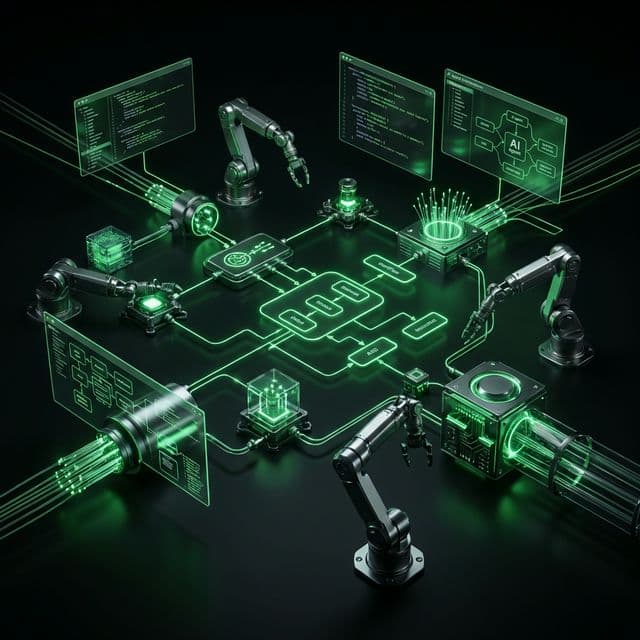
Building Multi-Agent Systems from Scratch: A Practical Guide
Single agents are great. But real-world problems? They're messy, multifaceted, and often require expertise across multiple domains. That's where multi-agent systems come in.
I've been building multi-agent systems for the past year, and I'll tell you — the gap between "cool demo" and "production system" is wider than most tutorials suggest. Here's what I've learned.
Why Multi-Agent?
The case for multiple agents is simple: specialization beats generalization.
A single agent trying to research, write, edit, fact-check, and format is like asking one person to be a journalist, editor, designer, and fact-checker simultaneously. It can work for simple tasks, but quality degrades fast as complexity increases.
Multiple specialized agents means:
- Better quality — each agent focuses on what it does best
- Easier debugging — when something goes wrong, you know which agent failed
- Scalability — add new capabilities without rewriting existing agents
- Parallel execution — independent tasks run simultaneously
The Four Architecture Patterns
1. Sequential Pipeline
Agents run in order, each passing output to the next:
Researcher → Writer → Editor → Publisher
Best for: content generation, data processing, ETL workflows
Pros: Simple, predictable, easy to debug Cons: Slow (sequential bottleneck), no parallelism
2. Hierarchical (Manager-Worker)
A manager agent delegates tasks to worker agents:
        Manager
       /   |   \
  Research Write  Review
Best for: complex projects with clear subtasks
Pros: Dynamic task allocation, good error recovery Cons: Manager is a single point of failure
3. Collaborative (Peer-to-Peer)
Agents communicate directly with each other:
Agent A ←→ Agent B ←→ Agent C
      ↕              ↕
   Agent D ←→ Agent E
Best for: creative tasks, brainstorming, debate-style refinement
Pros: Flexible, emergent behaviors, diverse perspectives Cons: Harder to control, potential for infinite loops
4. Hybrid
Combine patterns based on your workflow. In practice, most production systems are hybrid.
Designing Agent Roles
This is where most people go wrong. They create too many agents with overlapping responsibilities. Here's my framework:
Each agent should have:
- A clear, single responsibility
- Defined inputs and outputs
- Specific tools it can use
- Success/failure criteria
- An explicit personality or expertise
Bad agent design:
Agent: "General AI Assistant"
Role: "Help with various tasks"
Good agent design:
Agent: "Technical Research Analyst"
Role: "Find and synthesize technical information from documentation,
       papers, and code repositories. Return structured research briefs
       with citations."
Tools: [web_search, arxiv_search, github_search, document_reader]
Output: JSON with { findings, sources, confidence_level }
Communication Patterns
How agents talk to each other matters enormously. Get this wrong, and your system is either too chatty (slow and expensive) or too quiet (agents miss critical context).
Message Passing
The simplest approach. Agents send structured messages:
{
  "from": "researcher",
  "to": "writer",
  "type": "research_complete",
  "payload": {
    "topic": "AI Agent Memory Systems",
    "findings": [...],
    "sources": [...]
  }
}
Shared State
All agents read from and write to a shared state object. This works well when agents need to see each other's progress:
state = {
    "research": { "status": "complete", "data": {...} },
    "draft": { "status": "in_progress", "content": "..." },
    "review": { "status": "pending" }
}
Event-Driven
Agents publish events, and other agents subscribe to relevant ones. This is the most scalable pattern but also the most complex to implement.
Error Handling That Actually Works
Multi-agent systems fail in creative ways. Here's how to handle it:
- Retry with backoff — transient failures (API timeouts, rate limits) should trigger automatic retries
- Fallback agents — if your primary research agent fails, have a backup that uses different data sources
- Circuit breakers — if an agent fails repeatedly, stop sending it tasks and alert a human
- Graceful degradation — if the fact-checking agent is down, publish with a "not fact-checked" flag rather than blocking everything
The golden rule: never let a single agent failure crash the entire system.
Practical Example: Content Generation Pipeline
Here's the multi-agent system powering this very blog:
| Agent | Role | Tools | Output |
|---|---|---|---|
| Trend Scout | Find trending topics | HN API, RSS feeds, Reddit | Topic + keywords |
| Researcher | Gather source material | Web scraper, search | Research notes |
| Writer | Generate article draft | LLM with system prompt | Markdown draft |
| SEO Validator | Check SEO quality | Custom validation rules | Score + feedback |
| Publisher | Save and deploy | File system, Supabase, Git | Published post |
The pipeline runs sequentially, but the Trend Scout and Researcher could easily run in parallel for multiple topics.
Lessons Learned
After building several production multi-agent systems, here's my honest assessment:
Start with 2-3 agents. Seriously. Don't build a 10-agent system on day one. Start with a researcher and a writer, get that working perfectly, then add agents incrementally.
Observability is non-negotiable. You need to see every message, every decision, every tool call. Without this, debugging is impossible.
Human-in-the-loop isn't a weakness. Having a human approve critical decisions isn't a limitation — it's a feature. Build approval gates into your workflow.
Cost adds up fast. Each agent call is an LLM call. A 5-agent pipeline with 2 retries means up to 15 LLM calls per task. Price that out before production.
Multi-agent systems aren't magic. They're distributed systems with an AI twist. Apply the same engineering rigor you'd apply to any production architecture, and they'll serve you well.
Related Articles
Top AI Agent Frameworks to Watch in 2026
A comprehensive comparison of the best AI agent frameworks in 2026 — from LangGraph to CrewAI, OpenAI Agents SDK to AutoGen. Find the right tool for your use case.
OpenAI Agents SDK: The Complete Getting Started Tutorial
Master the OpenAI Agents SDK with this hands-on tutorial. Build your first AI agent with tool use, handoffs, guardrails, and tracing in under 30 minutes.
MCP Explained: The Model Context Protocol Reshaping AI
Model Context Protocol (MCP) is changing how AI agents interact with tools and data. Here's what every builder needs to know about this game-changing standard.