
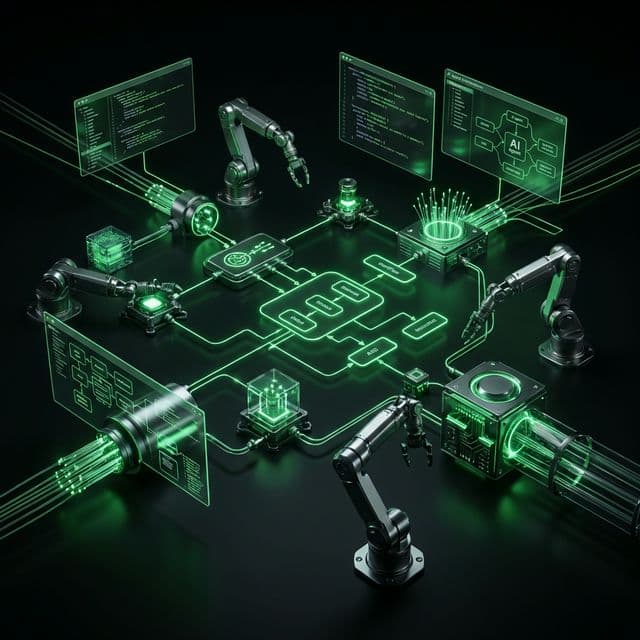
MCP Explained: The Model Context Protocol Reshaping AI
You've probably heard the buzz. MCP — the Model Context Protocol — is everywhere right now. And honestly? It deserves the hype.
Think of MCP like USB-C for AI. Before USB-C, you had a drawer full of tangled cables. HDMI, micro-USB, Lightning, DisplayPort — each device demanded its own connector. MCP does for AI what USB-C did for hardware: it creates one standard interface that works with everything.
What Exactly Is MCP?
MCP is an open protocol that standardizes how AI applications connect to external data sources and tools. Anthropic originally developed it, but it's now an open standard that anyone can implement.
Here's the core idea: instead of building custom integrations for every AI tool combination, you build one MCP server, and any MCP-compatible client can use it. Simple. Elegant. And honestly, long overdue.
The protocol defines three key primitives:
| Primitive | What It Does | Example |
|---|---|---|
| Resources | Expose data for the AI to read | Database records, file contents, API responses |
| Tools | Let the AI take actions | Send emails, create files, query databases |
| Prompts | Provide reusable prompt templates | Code review template, analysis workflow |
Why Should You Care?
Here's what I think makes MCP genuinely important — it's not just another API wrapper.
1. Composability. Build an MCP server once, use it everywhere. Your Slack MCP server works with Claude, ChatGPT, Cursor, and any other MCP-compatible client. No more rebuilding integrations.
2. Security built in. MCP runs locally by default. Your data doesn't need to leave your machine. The AI connects to your tools through local servers, not cloud-based proxies.
3. Context without copying. Instead of pasting your codebase into a chat window, the AI can directly access your file system, databases, or APIs through MCP. Real-time, always up to date.
How MCP Works Under the Hood
The architecture is refreshingly simple:
- MCP Hosts are the AI applications (Claude Desktop, IDE plugins, etc.)
- MCP Clients maintain connections between hosts and servers
- MCP Servers expose capabilities through the standard protocol
When you ask Claude to "check my latest database metrics," it doesn't magically know your database schema. Instead, it routes the request through an MCP client to your database MCP server, which executes the query and returns structured data.
But here's the real question — does this actually scale in production?
Building Your First MCP Server
Getting started is surprisingly straightforward. Here's what a minimal MCP server looks like:
import { McpServer } from "@modelcontextprotocol/sdk/server/mcp.js";

const server = new McpServer({ name: "my-tool", version: "1.0.0" });

server.tool("get-weather", { city: z.string() }, async ({ city }) => {
  const data = await fetchWeather(city);
  return { content: [{ type: "text", text: JSON.stringify(data) }] };
});
That's it. You've just created a tool that any MCP-compatible AI can use. No authentication dance, no webhook setup, no API documentation to write.
The Ecosystem Is Exploding
In my view, the most exciting part isn't the protocol itself — it's what people are building with it:
- Database connectors for PostgreSQL, MySQL, MongoDB
- Cloud platform integrations for AWS, GCP, Azure
- Developer tools connecting to GitHub, Jira, Linear
- Knowledge bases wrapping Notion, Confluence, and internal wikis
The community has already built hundreds of MCP servers, and the pace is accelerating.
What This Means for AI Agents
This is where it gets really interesting. MCP isn't just about chatbots accessing tools. It's the foundation for truly autonomous AI agents.
An AI agent with MCP access can:
- Read context from your codebase, documentation, and databases
- Take actions like creating pull requests, sending messages, or updating records
- Chain operations by using multiple MCP servers in sequence
- Maintain state across complex multi-step workflows
We're moving from "AI that answers questions" to "AI that gets things done." MCP is the infrastructure making that transition possible.
Getting Started Today
If you're building AI applications, MCP should be on your radar right now. Here's my recommended approach:
- Start with existing servers — the MCP registry has hundreds of ready-to-use servers
- Build one custom server for your most-used internal tool
- Test with Claude Desktop — it has native MCP support
- Scale to production once you've validated the workflow
The protocol is still evolving, but the foundation is solid. And honestly, the teams that adopt MCP early are going to have a massive advantage as AI agents become the default way we interact with software.
The future isn't just AI that can talk. It's AI that can do. And MCP is making that future arrive faster than anyone expected.
Related Articles
Top AI Agent Frameworks to Watch in 2026
A comprehensive comparison of the best AI agent frameworks in 2026 — from LangGraph to CrewAI, OpenAI Agents SDK to AutoGen. Find the right tool for your use case.
RAG: The Ultimate Guide to Retrieval-Augmented Generation
Everything you need to know about RAG — from basic architecture to advanced techniques like hybrid search, reranking, and agentic RAG pipelines.
AI Agents vs Chatbots: Understanding the Key Differences
AI agents and chatbots might seem similar, but they're fundamentally different. Here's a clear breakdown of what separates them and why it matters for your projects.